
Climate change is affecting all businesses and Sealord is committed to playing its part. Our climate change response is grouped into two categories – mitigation and adaptation.
1. Mitigation – measuring and setting targets to reduce greenhouse gas emissions and our carbon footprint through changing our operational approach.
Sealord is committed to disclosing our progress toward reducing our carbon footprint and is a member of the Aotearoa Circle and Nelson Businesses for Climate Action groups.
2. Adaptation – understanding and responding to climate risk by developing plans to adapt to extreme weather and rising sea temperatures.
In 2023, Sealord worked with the Aotearoa Circle in developing a Seafood Sector Adapation Strategy with climate adaptation pathways proposed for hoki, salmon and snapper. A signicicant component of these pathways will require further work on understanding juvenile fish behaviour, the development of alternative fuels and reviewing fish regulations with regard to fish movements as the sea temperature increases. This report is available here:
This was followed up in 2025 with a multi-party group developing marine climate scenarios to enable transition planning for different climatic outcomes. This was coordinated by Aotearoa Circle and included seafood industry operators (Sealord, Moana, Sanford, NZ King Salmon), science organisations (Plant and Food, Cawthron, NIWA) and the NZ Government department (Fisheries New Zealand). A copy of this report is available here.
What are CO2e units?
A CO2e unit is the standard international measure for greenhouse gases. A CO2e unit bundles the different greenhouse gases into one common unit (carbon dioxide, or CO2).
The other gases, such as methane, are measured in terms of their equivalent CO2 global warming effect and included in the CO2e bundle. This provides a complete measure of greenhouse gas emissions than if we measured CO2 alone.
Reducing our carbon footprint
Since 2019, Sealord has measured its carbon footprint annually to better understand our effect on the environment. This footprint is independently audited by an environmental verification company, McHugh Shaw, each year. Most of our footprint (approximately 79 per cent) comes from the fuel that propels our vessels. We have several initiatives in place to reduce this footprint; these align with international science-based carbon reduction targets (the Paris Agreement).
Sealord’s fishing business has 2019 as a baseline year and the aquaculture business has a baseline year of 2022 recognising when full operational control occurred,
In early 2024, Sealord purchased 100% ownership of Independent Fishing Limited (IFL) which will operate as a wholly owned subsidiary. IFL’s carbon footprint was measured in 2025 and this year will be used as IFL’s baseline year.
For the Sealord Group, we have elected no to re-set a baseline year with the addition of IFL and are managing different baseline years across the three entities (Sealord Fishing, IFL and Aquaculture).
We have two areas of focus:
Firstly, our New Zealand operations represent the largest proportion of our footprint with our vessels fishing around New Zealand and our factory in Nelson. In New Zealand, our objectives are to reduce our Scope 1 and 2 emissions in line with international science-based targets that align with the Paris Accord.
Scope 1 emissions will be very difficult to full abate. Sealord reviews of vessels to be retired (and replaced with more efficient vessels) on an ongoing basis as well as assessing new alternative fuel options as they become available.
In 2024, Sealord retired the Otakou from service. In 2026, the Thomas Harrison will only operate for 18 weeks a year servicing our wet fish factory. Additionally in 2026, Sealord’s vessel (Will Watch) operating in the Indian Ocean will be replaced with a newer more fuel efficient vessel, Te Hikitia with a refrigeration system that does not use Green House Gases. These three initiatives will assist Sealord in achieving the science aligned targets out to 2027 with a reduction in Sealord’s Scope 1 emissions.
Despite being on track, these targets will be reviewed in 2025 as it has become more evident that a reduction to a Net Carbon Zero by 2050 will not be achieved within our fishing businesses due to a lack of available fuel and technology.
Our Scope 3 emissions are largely (77%) sea freight based. After analysis of shipping routes and carriers, Sealord has limited options to reduce these emissions. Our shipping partners need to introduce new propulsion technology onto vessels servicing routes to and from New Zealand.
We have taken an active watching brief on these Scope 3 emissions and are encouraging shipping companies to consider new vessels into this region as they are built and put into service. Most global sea freight companies have Net Carbon Zero targets of 2040-2050 to 2050-2070 to reflect their capital investment and bio-fuel availability. Our Scope 3 carbon reduction glide paths will be re-modelled to reflect this.
Our second area of focus is our Australian aquaculture business in Tasmania (Petuna) growing salmon and ocean trout. Petuna emissions were added to the Sealord Groupls emissions in 2022.
With a significant proportion of Petuna’s emissions being Scope 3, using fish feed, our focus is on total carbon emissions. As we are growing more fish, it is also appropriate that an intensity measure is considered as well (the amount of CO2e per kilogram of fish growth per kilogram). Our goal is that both measures should reduce over time aligned with science- based targets.
Our annual Emissions Inventory Report is available on request. Please use the Contact Us email [email protected] for a copy.
Year ending 30 /9/2019
Year ending 30 /9/2025
Year ending 30 /9/2019
Year ending 30 /9/2025
In 2019, Sealord undertook to measure our carbon footprint as part of the sustainability policy. Our baseline emissions are detailed in the figures as at the year ending September 30, 2019. These are broken down into Scope 1 – 94,016 tCO2e, Scope 2 – 1,137 tCO2e (total S1 and S2 emissions are 95,153 tCO2e) and Scope 3 – 19,003 tCO2e.
From this starting point we have developed programs to reduce this over time, in line with our commitment to address Climate Change.
In the year ending September 30, 2025, Sealord NZ achieved a reduction from 2019, of 24% of Scope 1 and 2 emissions to 72,671 tCO2e. Vessel fuel accounted for 93.9% of these emissions.
Since our baseline year within New Zealand, Sealord have removed just under 22,477 tCO2e from our operations in line with the international science-based targets. This equates removing to over 5,000 vehicles from our roads.
Our Scope 3 emissions in New Zealand were 22,830 tCO2e of which freight was 79%.
The pie chart shows the total emissions sources by operational area.

IFL Fishing was added to the Sealord Group in 2025. IFL’s emissions were 43,877 tCO2e Scope 1, 225 tCO2e Scope 2 and Scope 3 emissions were 9,935 t CO2e. IFL’s Scope 1 and 3 emissions profile is very similar to Sealord Fishing with 3 vessels operating. IFL’s Scope 2 emissions relate to the IFL cold store in Christchurch.
While Sealord Group will report total emissions as detailed above, IFL will have 2025 as its baseline year.
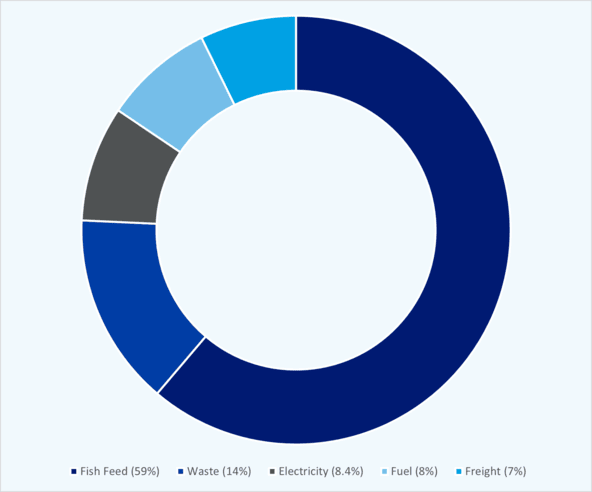
Sealord’s aquaculture business has a baseline carbon footprint of 29,114 tCO2e (Scope 1 – 2,562 tCO2e, Scope 2 – 2,440 tCO2e, Scope 3 – 24,110 tCO2e). Scope 3 emission are largely fish feed with 71% from this source. The baseline intensity measure for aquaculture is 4.07 kg CO2e per kilogram of net fish growth (removing any mortality biomass). Emissions due to waste (landfill) as a percentage is high in 2025 due to a mortality issue at one of the salmon farms.
In the year ended September 30, 2025, the aquaculture business overall carbon decreased by 12% to 28,935 tCO2e. This is also 17% (5,564 tCO2e) below the 2022 baseline. This was largely due to the closure of the Barramundi farm in Queensland.
Due to a mortality issue on one of the salmon farms, the intensity measure (kgCO2e per kilogram of net growth) increased by 10% to 4.12 kgCO2e per kilogram. This was above the with science- based targets although 4% below the 2022 baseline intensity measure.
While this figure increased this carbon intensity measure remains the lowest in salmon aquaculture in Australia due to our unique land-based operations in Rowella.
Pie chart Australia Emissions by Operational Category (tonnes CO2e)
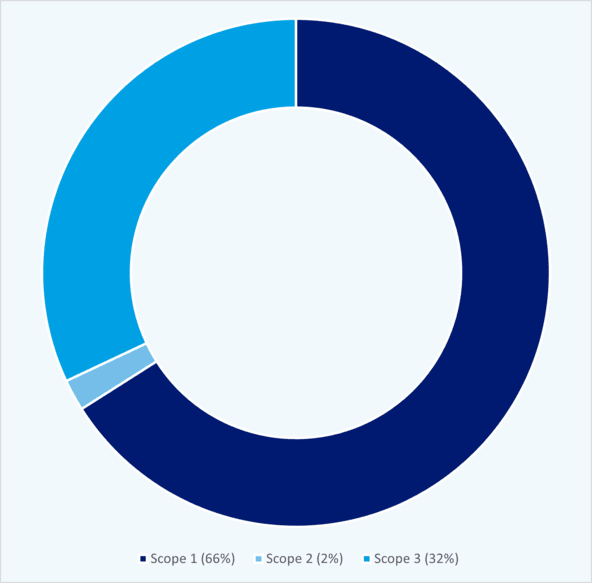
Sealord Group’s baseline emissions in the year ended Sept 30, 2019 were 120,090 tCO2e. New Zealand operations were 94.9% of this footprint.
In 2025, with the inclusion of IFL total emissions increased by 54,058 t cO2e and are now 177,411 tCO2e and New Zealand’s percentage is 83% of emissions.
Pie chart total Sealord Group Emissions by Scope (tCO2e)
Sealord Fishing have established international science-based targets for the New Zealand operations from the 2019 baseline. These are designed to meet the requirements of maintaining global temperatures to a maximum of +1.5 degrees above pre-industrial temperatures. This is in line with the more aggressive guidelines established in the Paris Agreement (versus a +3.0 degree scenario). These targets deliver a Net Carbon Zero position in 2050.
The graphs below represent the carbon reduction each year for the Sealord Fishing business in New Zealand since the 2019 baseline. In 2025, Sealord did not meet the science-based targets, and cumulatively since the 2019 the business is above the agreed targets by 1,497 t CO2e
As Sealord is focussed on more controllable emissions, the below represents progress on Scope 1 and 2 emissions only
A detailed above, the aquaculture business did not meet the science-based targets in 2025 on an intensity basis and remain above the cumulative target. A key to aquaculture achieving this going forward will be a move to a low carbon fish feed and avoiding any mortality issues caused by higher water temperature and salinity.